
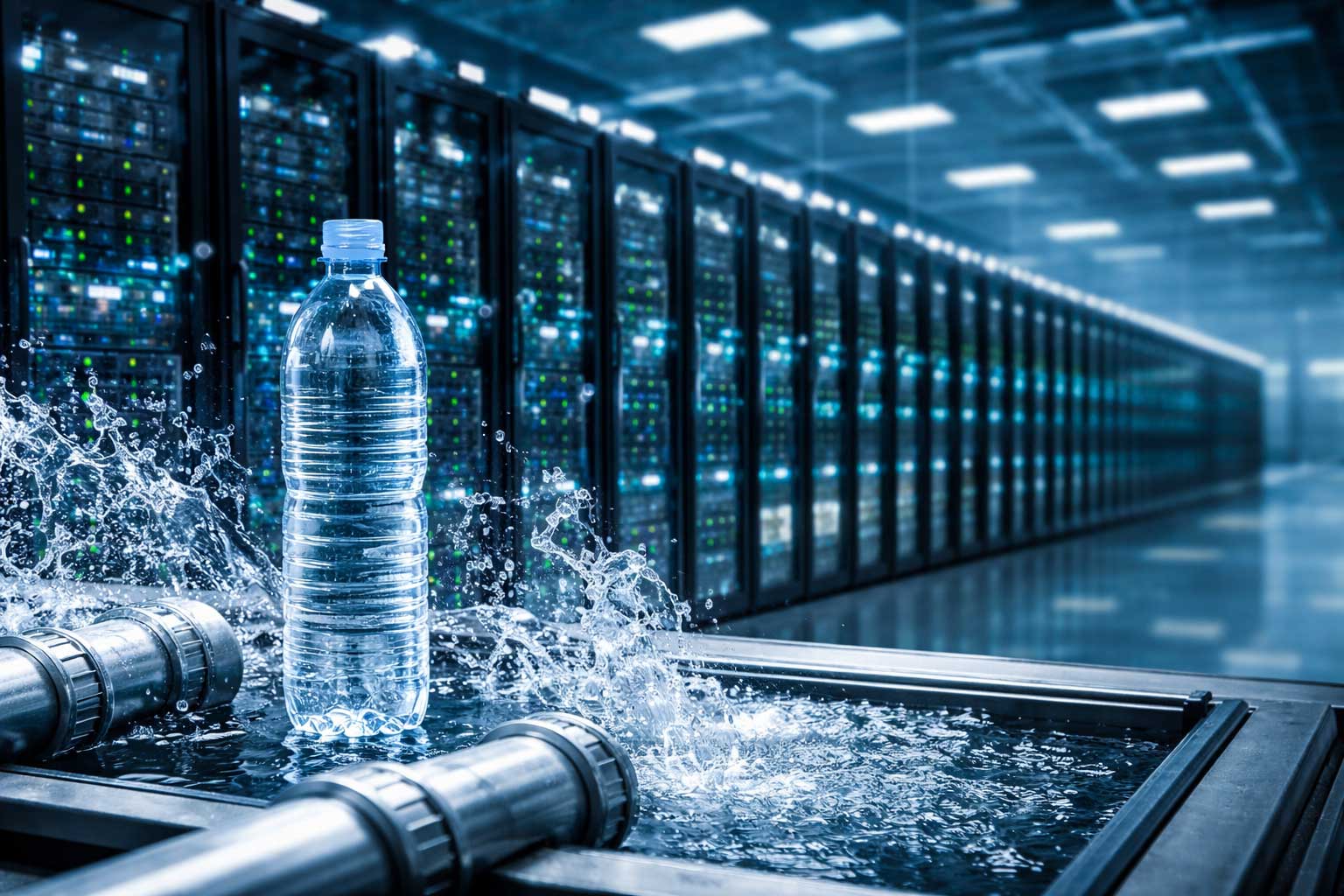
How Much Water Does AI Consume? The Real Numbers Behind “Thirsty” Chatbots
AI doesn’t literally “drink” water — but the data centers that power AI often use water to remove heat from servers.
Here’s what researchers and major tech disclosures suggest about water use for everyday AI prompts, training large models, and the global impact as AI demand grows.
Why AI Uses Water in the First Place
Modern AI runs on racks of high-performance chips (GPUs/TPUs) that generate intense heat. Many data centers control that heat using:
- Evaporative cooling (cooling towers that evaporate water — often “consumed” and not returned)
- Chilled water loops (water circulates to absorb heat; some losses still occur)
- Hybrid systems that switch methods depending on weather and electricity prices
So when people talk about “AI water use,” they’re usually talking about the water used indirectly to cool compute infrastructure.
Water Used Per Prompt (Inference): Why You See Conflicting Numbers
This is the most confusing part because estimates vary wildly based on:
- model size and how long the response is
- data center cooling design (air-cooled vs water-cooled)
- local climate (hot/dry regions can increase water consumption)
- when you measure (peak loads vs averages)
Commonly Cited Estimate: “500 mL for 20–50 prompts”
One widely shared estimate suggests that roughly 20 to 50 prompts can be associated with about 500 mL (a bottle) of water consumption in certain conditions, largely due to water lost as evaporation (“steam emissions”). This figure is frequently cited in media coverage referencing academic work.
Lower/Alternative Estimates Also Exist
Other analyses argue the “bottle per short conversation” claim is often overstated or too dependent on specific assumptions (like the exact data center location, cooling method, and workload). The best takeaway is:
- Per-prompt water use is not a fixed number.
- It can range from tiny (drops) to much higher depending on infrastructure and demand.
Water Used for Training (Teaching the Model)
Training large AI models is usually far more water- and energy-intensive than answering individual prompts, because training runs huge clusters of chips at high utilization for long periods.
For example, training a GPT-3-scale model has been estimated to require substantial freshwater consumption for cooling (commonly cited in the hundreds of thousands of liters). The exact number depends on the training setup and the data center’s water intensity.
Big Tech Water Use: What Public Reporting Shows
AI is just one part of data center operations, but it’s an increasingly significant driver. Public environmental reporting has shown large-scale water usage for cooling, especially as high-performance computing grows.
- Google reported its data centers used 6.1 billion gallons of water in 2023 (about 23 billion liters), with a reported year-over-year increase tied to rising cooling needs for high-performance computing infrastructure.
Global Projections: How Big Could AI’s Water Footprint Get?
Some projections estimate that global AI-related water withdrawals could reach 4.2 to 6.6 billion cubic meters by 2027. That’s a massive number — measured at a global scale — and is part of why researchers and universities are calling for better transparency and water-smart infrastructure planning.
Quick Facts Table
Is AI Water Use a Big Deal?
It can be — especially in water-stressed regions. The controversy isn’t only about total global volume, but about where water is drawn from and whether it competes with community needs during droughts.
At the same time, water use can be reduced with:
- air cooling / “dry” cooling where feasible
- reclaimed or non-potable water instead of freshwater
- better scheduling (running heavy compute when temperatures are lower)
- efficiency improvements in models and hardware
FAQ
Does every ChatGPT/Gemini question really use a bottle of water?
Not always. The “bottle per 20–50 prompts” figure is a commonly cited estimate for certain assumptions. Real-world numbers can be lower or higher depending on the data center and workload.
Why do some sources claim “drops per prompt” while others say “bottles”?
Because they’re often using different assumptions: cooling system type, location, water intensity per kWh, and what they include (direct cooling only vs broader lifecycle impacts).
Is training worse than everyday usage?
Generally, yes. Training runs massive compute clusters for long periods. That concentrates energy use (and cooling needs) into a short time window.
Is AI water use “consumption” or “withdrawal”?
It can be either, depending on the metric. “Withdrawal” means water taken from a source; some may be returned. “Consumption” often means water that is evaporated or otherwise not returned to the local system.
Can AI be cooled without freshwater?
Often, yes — through air cooling, closed-loop systems, or reclaimed water. But tradeoffs include cost, local infrastructure, and higher electricity demands in some designs.
Sources & Further Reading
- University of California, Riverside (2023) — AI programs consume large volumes of scarce water
- OECD AI (2023) — How much water does AI consume?
- University of Illinois (2024) — AI’s challenging waters and projections
- UNRIC (2025) — AI energy and water demand projections
- NDTV (2026) citing Google environmental reporting — data center water use
- Gupta et al. (PDF) — AI’s excessive water consumption (SDGs)
Note: Water estimates for “per prompt” usage vary across studies and depend heavily on infrastructure and assumptions. The most reliable approach is to treat single-number claims as approximations, not universal constants.

Leave A Comment